When the Maine Woods Grow Quiet

A Maine MooseGurl reflection on winter ticks, changing woods, conservation, and hoping Maine's moose will be here for generations to come.
There are mornings in the Maine woods that leave me a little bewildered.
The other morning, I found myself sitting quietly on the edge of a pond as the sun started to rise over the Maine woods. Mist was still hanging over the water, and for a while, I just sat there.
Listening.
Waiting.
Thinking about what I once would have expected to hear—or see—with enough patience.
A splash in the shallows.
The snap of a branch.
The unmistakable sound of a moose feeding somewhere just out of sight.
But the pond was quiet.
Wildlife is just that—wild. There are no guarantees. Moose move. Their habits change with the seasons, weather, food, pressure, and countless other things happening in these woods.
When you spend enough time out here, you notice changes.
When Familiar Places Become Quieter
Our time in the woods isn't simply spent driving back roads hoping to stumble across a moose.
It's hiking old cuts, checking ponds and feeding areas, looking at tracks and sign, sitting quietly, waiting, watching and studying—day after day, season after season.
Over time, you begin to notice when places that once held moose become quieter.
I notice the cows I'm seeing without calves beside them.
I remember the years when seeing twins didn't seem quite so unusual, and now I'm grateful when I see a cow successfully raising even one.
I see younger bulls and sometimes find myself wondering where some of those big, mature bulls I once watched have gone.
And there is something else I have started noticing that is harder for me to talk about.
Every once in a while now, we have a mooseless tour.
Of course, wildlife has never come with guarantees. I have always told people that. These aren't animals in a park waiting for us to arrive. They're wild animals living in thousands upon thousands of acres of Maine woods.
But years ago, going out and not finding a moose wasn't something I really worried about.
I knew these woods. I knew the ponds. I knew the cuts and the feeding areas. We did our legwork, put in the time, and sooner or later, we usually found them.
Today, occasionally, we don't.
Those are hard days for me.
Someone may have traveled hundreds or even thousands of miles to Maine, and seeing a moose may be one of the things they've dreamed about for years. I know I can't control wildlife, and I know I've done everything I can do.
But when we pull back into Greenville without having found one, I still feel it.
Part of that is disappointment for my guests.
But if I'm being truthful, there's something else underneath it.
It worries me.
Is it simply one of those days when the moose were somewhere else?
Did I miss them by five minutes?
Did they move into another piece of country?
Or am I watching something slowly change in the woods I've spent so much time learning?
I don't know.
And I think it's important for me to say that.
None of these observations, by themselves, tell the whole story of Maine's moose population.
Moose move. Seasons are different. Habitat changes. What I see in my little corner of the Maine woods is only one piece of a much bigger picture.
But when your boots have traveled these same roads, cuts, and pond edges year after year, you can't help but notice when something feels different.
And you can't help but wonder why.

Our Working Forests Matter
One thing we are fortunate to have in the Moosehead Lake Region is an incredible working forest.
The wood companies harvesting in our area do an exceptional job of creating openings and regenerating young forest that can provide tremendous feeding areas for moose.
I've spent countless hours walking and watching those cuts. They can be some of the best places to find moose because of the new growth available to them.
There is food here.
There is habitat here.
And yet another part of the story that weighs heavily on those of us who love these animals.
Winter Ticks and Maine's Moose
Winter ticks are not the same as the deer ticks most of us think about when we hear the word "tick."
A winter tick can spend months on a single moose, and a heavily infested animal can carry tens of thousands of them.
The effect can be devastating, particularly for calves.
Maine's wildlife biologists have been studying winter ticks and their effect on our moose for years. The Maine Department of Inland Fisheries and Wildlife reports that winter ticks are the leading cause of death for Maine moose under one year old in the state's core moose range.
Adult cows can be affected as well. Their physical condition and reproductive success can suffer following significant tick infestations.
That's why, when I'm standing in the woods looking at another cow without a calf beside her, I wonder.
I can't say what happened to her calf.
Maybe she never had one that year. Maybe something else happened. Maybe that calf is somewhere I simply haven't seen.
That's wildlife.
But knowing what our biologists are documenting makes it difficult not to think about it.
What About the Future of Maine's Moose?
This is where I think we need to be careful.
What I am observing locally does not mean that I can tell you Maine's entire moose population is disappearing.
Maine's wildlife biologists have far more information available to them than I could ever gather from my time in the woods.
I'm simply telling you what I'm seeing.
And I'm asking questions.
Because low calf survival and reduced reproductive success matter when we start looking years and decades into the future.
That's what worries me.
Not just tomorrow morning's moose tour.
Ten years from now.
Twenty years from now.
Could Something in the Forest Help Fight Winter Ticks?
There is also some fascinating research happening elsewhere in the Northeast that gives me a little hope.
Researchers at the University of Vermont have been studying naturally occurring fungi that can infect and kill ticks.
These are called entomopathogenic fungi—basically fungi that naturally attack insects and other arthropods.
Scientists have been studying whether fungal biopesticides could someday help control winter-tick larvae while the ticks are off the moose and living in the environment.
Laboratory studies involving certain Metarhizium fungi have produced encouraging results against winter-tick larvae.
That does not mean we've found the answer.
Something that works inside a laboratory is very different from figuring out how—or whether—it could safely and practically work across the enormous forests that moose call home.
Still, I find something hopeful about the research.
Maybe somewhere beneath our feet, in the soil of these forests, nature holds another piece of the puzzle.
Hunting Is Part of My Story, Too
There's something else I want to say because I think it's important—especially here in Maine.
I don't hunt. But hunting is very much a part of my family's history.
I grew up understanding that hunting wasn't simply about getting an animal.
For my family, and for generations of Maine families, hunting was one of the ways you provided.
It put food on the table.
It filled the freezer.
It helped feed a family.
That history is part of my history, too.
I made the personal choice not to hunt, but that doesn't mean I've forgotten where I came from or that I don't respect those who responsibly continue that tradition today.
For many Maine families, hunting is still about far more than harvesting an animal.
It's hunting camp.
It's fathers and daughters, mothers and sons, grandparents and grandchildren heading into the woods together.
It's stories told around the table.
It's knowing how to read a track and how to move through the woods.
It's knowledge passed from one generation to another.
And yes, for many families, it's still food for the freezer.
I understand that because it is part of where I came from.
That's why I don't believe hunters and those of us who would rather watch a moose through binoculars or through the lens of a camera have to stand on opposite sides when we talk about conservation.
Our reasons for loving these animals may be different.
The way we experience them may be different.
But at the heart of it, I believe many of us want the same thing:
A healthy moose population that will still be here for generations to come.
I want there to be moose for the hunter carrying on a family tradition.
I want there to be moose for the child staring out the window on their first trip to Maine.
I want there to be moose for the photographer who has waited hours beside a pond.
And yes, I want there to be moose for me to find when I head down those dirt roads before daylight with people who may have dreamed their entire lives of seeing one.
Because when I worry about the future of Maine's moose, I'm not standing outside Maine's hunting heritage looking in.
It's part of my story, too.
Conservation Doesn't Always Have Easy Answers
Maine wildlife managers are studying different ways to protect the long-term health of the moose population.
One approach being researched in Maine has involved reducing moose density within a controlled study area to determine whether fewer hosts can interrupt the winter-tick cycle and ultimately result in healthier moose.
For someone like me who loves seeing moose alive in these woods, that can be difficult to wrap my heart around.
But conservation isn't always simple.
Sometimes caring about wildlife means being willing to listen to the science, ask difficult questions and recognize that people who care deeply about the same animal may approach its conservation differently.
Moose Are Part of the Story of Moosehead
For me, this isn't only a wildlife issue.
Moose are part of Maine's heritage.
They are part of our working forests and our wild places.
And here in the Moosehead Lake Region, they are part of what brings people from across the country—and around the world—to experience this corner of Maine.
People come here hoping for that moment.
That first glimpse of long legs through the spruce.
A cow standing quietly beside her calf.
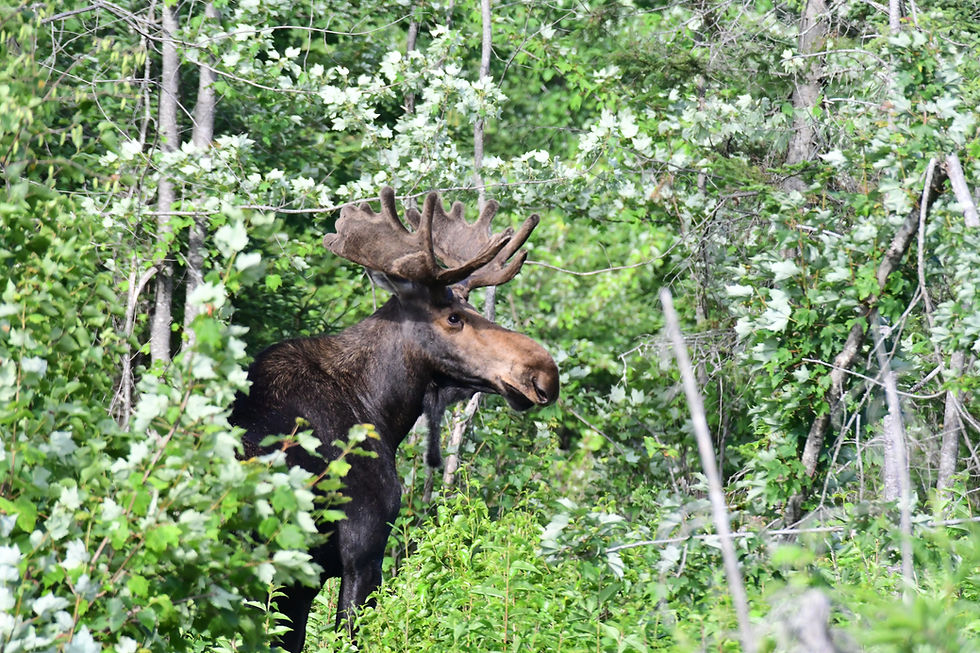
A mature bull stepping from the brush in September carrying an antler rack that makes you whisper, Wow.
I get to watch people's faces when that happens.
And I know what those moments mean.
Maybe that's another reason those occasional mooseless tours stay with me.
It isn't simply that we didn't see an animal that day.
It's knowing how much that moment meant to the person sitting beside me—and wondering whether finding that moment will become harder for the generations that come after us.
I also think about what that could someday mean for communities like ours.
People travel to the Moosehead Lake Region because they want to experience something that is becoming harder to find in many places: wild Maine.
The woods.
The water.
The loons.
The quiet.
And, of course, the moose.
Their future matters to conservation.
It matters to Maine's hunting heritage.
It matters to those of us who simply love watching them.
And it matters to the future of wildlife tourism in communities like ours.
I Hope the Silence Is Temporary
I don't pretend to have all the answers.
I'm not a wildlife biologist.
I'm just a woman who spends an awful lot of time wandering these woods, watching, listening, and learning.
And the other morning, sitting beside that quiet pond as the sun began to rise, I found myself remembering what I used to hear.
I hope the silence is temporary.
Because I don't want the stories of Maine's moose to become stories about what used to be here.
I want my grandchildren—and theirs—to be able to sit beside a Maine pond someday.
I want them to know what it feels like to wait.
To listen.
To suddenly hear the water rolling out of a moose as it grazes on water vegetation or, somewhere beyond the water, hear a twig snap.
And to hold their breath because they know exactly what's coming.
Whether we carry a camera, binoculars, or a hunting rifle, I hope there is one thing we can agree on:
Maine should always have wild places where a moose can step from the trees.
Wildly Maine
— Maine MooseGurl
About Maine MooseGurl
Maine MooseGurl has spent years exploring the back roads, logging country, ponds and working forests surrounding Maine's Moosehead Lake Region. Her knowledge of moose has grown from countless early mornings and long days in the woods—watching, listening, studying behavior and learning how these animals move through the changing seasons.
As part of Moosehead Area Guide Service, she shares that experience with visitors hoping to see and better understand Maine wildlife in its natural surroundings.
A lifelong Mainer, her passion goes beyond simply finding a moose. She believes in respecting wildlife, protecting Maine's wild places and helping future generations experience the sights and sounds that have made the North Woods so special to generations before them.
Through MooseGurl's Maine, she shares stories, observations and lessons gathered from time spent in the woods—always believing that sometimes the best way to understand the Maine woods is simply to slow down, get quiet and listen.


Comments